We get ideasoff the ground.
Starport turns startup ideas into real, working products. From first scope to first customer, we design, engineer and launch MVPs for founders.
You don’t need an engineering department to find out if your idea works.
Hiring a product team takes months. Traditional agencies answer a small question with an enormous scope. Vibe coding gets you surprisingly far, and then stops short of a product you can defend in front of paying customers.
Starport gives founders the product and engineering capability to launch without building the entire company first.
Three months before the first commit
Sourcing, interviewing, notice periods, onboarding. All of it spent before you learn anything about whether customers want the product.
A twelve-month scope for a one-month question
Big scopes are easier to bill and easier to sign off. They are also the slowest possible way to discover you were wrong about something.
Demos beautifully, breaks on contact
AI got you to eighty percent in a fortnight. The remaining twenty percent is auth, data integrity, payments, failure handling — and it is where the risk lives.
From idea to launch.
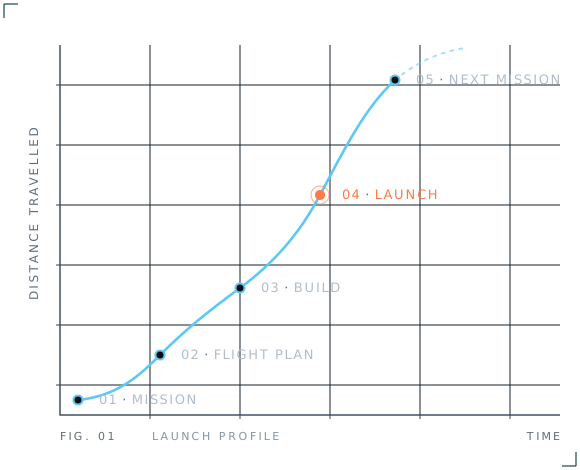
Five stages. The first two exist to make the third one small.
Mission
Understand the problem, the customer and the hypothesis. What are we actually trying to find out?
Flight Plan
Define the smallest product capable of testing it — and say plainly what is being left out.
Build
Design and engineer it in tight iterations. You see working software every week, not status reports.
Launch
Deploy it, put it in front of real users, and start collecting evidence instead of opinions.
Next Mission
Use what launch taught you to decide what deserves to be built next. Sometimes that is nothing.
Four ways to work with us.
Most founders start with Launch. The others exist because a product that works has a next thing it needs, and that is rarely a whole new agency.
Launch
The core engagement. We work out what actually needs to exist, design and engineer it, and get the first usable version into the hands of real users.
Dock
Bring us what you already have — a Figma file, a half-working demo, an application you vibe-coded to eighty percent. We assess it honestly, keep what is sound, and engineer the rest for real customers.
Boost
A focused engagement for one significant thing: a new feature, an integration, an AI capability, a platform expansion. Scoped, built and handed back.
Ground Control
Continued engineering, maintenance and iteration after launch, so the product keeps moving while you work out whether it is time to hire.
It has never been easier to build something. It is still hard to build the right thing well.
An MVP is not a cheap version of the final product. It is an experiment expressed as software, and its job is to answer something you cannot answer any other way.
Will people use it? Will they pay for it? Does this workflow actually solve the problem? Which part of the idea matters most?
We build less software so you can learn sooner — not because software is expensive.
AI makes us faster. Engineering makes it dependable.
AI has genuinely changed how quickly experienced engineers can build software, and that advantage should reach you as faster iteration and a smaller team — not as a badge on a website.
But generated code is not the product. Product judgment, architecture, security, data modelling, UX, testing and deployment still decide whether the thing survives its first real week. We use modern tools aggressively and stay accountable for what ships.
Bring us the mission.
Tell us the idea, the problem or the half-built thing. We’ll tell you what the smallest worthwhile first launch looks like.